
Custom software from Munich
Software that never used to pay for itself.
We modernise business systems that have grown over decades, replace legacy applications, and automate the processes nobody ever got round to automating. AI-assisted development has moved that line — noticeably.
Services
01
Three kinds of project we see again and again.
What they have in common: everyone already knows what the solution looks like. It was simply too expensive to build.
01
Modernising business systems
Your ERP, your inventory system or your planning tool carries the daily business — and slows it down at the same time. We modernise systems like these step by step rather than as one risky programme: one area is replaced at a time, and operations never stop.
02
Replacing legacy applications
Access databases, spreadsheets held together by macros, in-house tools whose author left years ago. They work — until they don’t. We move the business logic into maintainable software that is documented and testable, without losing the knowledge embedded in it.
03
Automating processes
Plenty of work is still done by hand because automating it never added up: too specific, too low a volume, too much effort. That calculation has changed. We build the automation that would have been uneconomical three years ago.
Use Cases
02
Where the effort pays off first.
Three situations we meet regularly — described generically, to show the shape of the work.
Technology
03
What we work with.
AI-assisted development for the build, test-driven steering for the quality. That combination is why projects add up today that did not before.
 Claude CodeImplementation
 OpenCodeImplementation
 CodexImplementation
 testup.aiSteering & QA
The actual work is still software engineering: understanding the domain, deciding the architecture, securing the quality. The tools speed up the build — they do not replace the judgement.
Why Thetaris
04
Why Thetaris.
We come from data analysis, not from the agency world
Our team has spent more than ten years on data-driven optimisation, with backgrounds in applied mathematics, data science, computer science and economics. It shapes how we approach a project: we want to understand where the costs and the bottlenecks actually sit before we build anything.
We deliver in steps you can judge
Large modernisation projects rarely fail on the technology. They fail because nothing usable appears for too long. We cut work so that after each stage something is in production that is worth having on its own — and that you can assess before commissioning the next step.
Automated tests are not a line item we negotiate away
Test automation is our second line of business — testup.ai is our own product in that field. When development gets faster, verification becomes the bottleneck. So test coverage grows alongside the build instead of being a later phase that gets cut when time runs short.
Team
05
One team, in Munich.
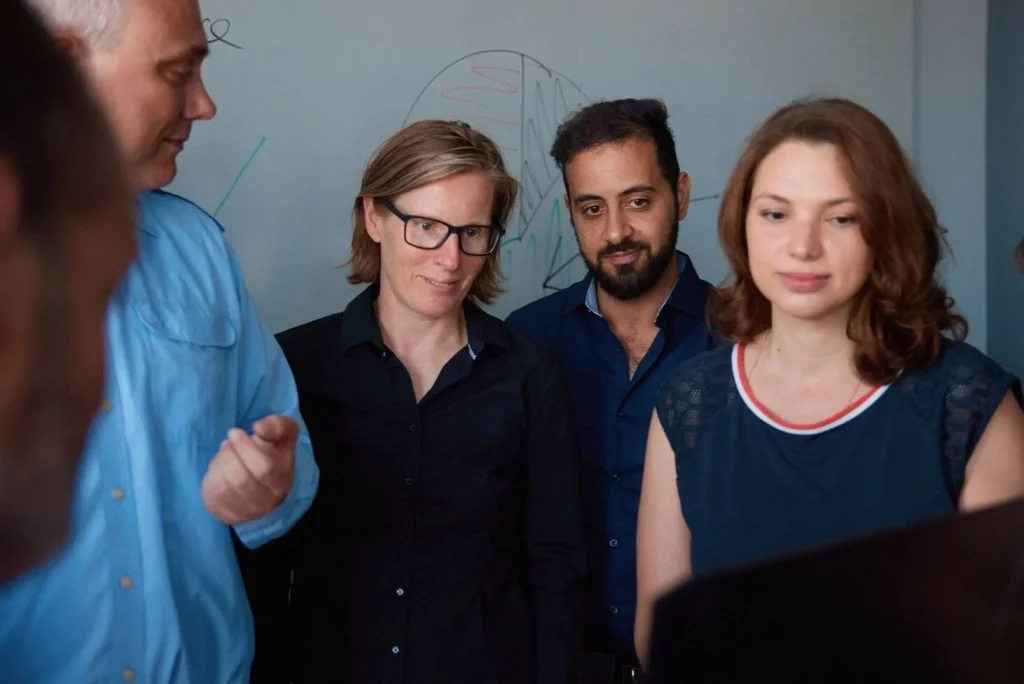
We are a small team of engineers and mathematicians based in Munich. No sales apparatus, no layers in between: the people you discuss the project with are the people who build it.
For over ten years we have worked where software, data and business meet — first in finance, today for companies that want to get their systems in order. We work in English and German.
Contact
06
Let’s talk it through.
A first conversation takes half an hour and costs nothing. Afterwards you will know whether your project is worth doing — even if the answer turns out to be no.
Prefer to write? info@thetaris.com or call +49 (0) 89 20 80 39 480.